
 As a Christian attorney, I am often confronted with statements such as, “I believe the Scriptures make it very clear that Christians should never take their brothers to court,” or “It is sinful and faithless for a Christian to seek legal counsel.” If those statements were true in the absolute sense they are often presented, then either God has said that civil law can only be conducted by nonbelievers, or my entire profession would be an ongoing exercise in sin. Yet I know that God has called me to defend His people, protect Kingdom assets, and stand for truth, justice, and righteousness within civil society.
Because of that calling, I believe it is important that my brothers and sisters in Christ be guided by sound biblical understanding rather than by repeated misunderstandings of Scripture. Too often, verses are quoted without context, applied beyond their intended purpose, or used in ways that unintentionally protect wrongdoing while silencing those who have been harmed. Scripture never commands Christians to become willing victims of fraud, abuse, theft, or oppression in the name of spirituality. Instead, God calls us to walk in truth, righteousness, accountability, wisdom, and justice.
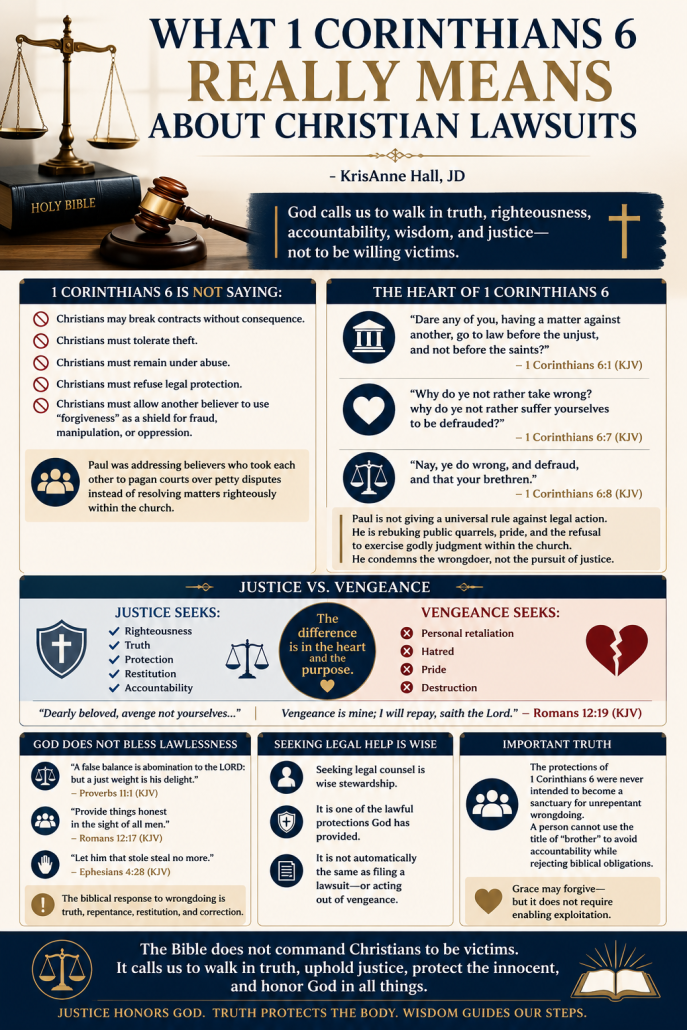
1 Corinthians 6 is not a command for Christians to remain victims. It is a rebuke against carnal, selfish, public quarrels that shame the Body of Christ. In this context, Paul is addressing Christians who were dragging one another before pagan courts over petty disputes, while refusing to exercise righteous judgment within the church.He is not saying:
Paul’s concern is not the proper exercise of lawful accountability. His concern is unrighteous contention, public shame, and the absence of godly judgment among believers. Paul writes:
“Dare any of you, having a matter against another, go to law before the unjust, and not before the saints?” (1 Corinthians 6:1, KJV). The issue is not merely “court” but that believers were choosing worldly judges over godly judgment for disputes that should have been resolved righteously within the church. Paul then says, “Why do ye not rather take wrong? why do ye not rather suffer yourselves to be defrauded?” (1 Corinthians 6:7, KJV). Thisverse is often misused. Paul is not giving a universal legal rule that Christians cannot take legal action and must always submit to being defrauded. He is exposing the shameful condition of their hearts: they were so eager to win against each other that they preferred public strife over humility, reconciliation, and righteousness. But Paul immediately adds, “Nay, ye do wrong, and defraud, and that your brethren.” (1 Corinthians 6:8, KJV). Paul does not excuse the wrongdoer; he condemns the defrauder. The Bible does not protect or excuse the one stealing, abusing, breaching trust, or violating covenant. He is rebuked by it, and that is what really matters in this context.
Then what is the biblical distinction? Scripture does not forbid Christians from pursuing justice; it forbids Christians from pursuing vengeance. Justice seeks righteousness, truth, protection, restitution, and accountability. “Dearly beloved, avenge not yourselves… Vengeance is mine; I will repay, saith the Lord.” (Romans 12:19, KJV) Vengeance seeks personal retaliation, hatred, pride, or destruction. The distinction is found not only in the action itself, but in the condition of the heart and the purpose behind it.
The protections of 1 Corinthians 6 were never intended to become a sanctuary for unrepentant wrongdoing. Paul’s instruction assumes genuine Christian conduct, humility, repentance, and submission to righteous judgment within the Body. A person cannot invoke the title of “brother” to avoid accountability while simultaneously rejecting the biblical obligations that accompany that profession.
At the same time, there may be circumstances where a Christian, out of love and mercy, chooses not to pursue legal action. If a true brother entered into an agreement in good faith but later fell on genuine hardship and is repentant, another believer may choose to bear that loss and forgive out of grace. But that is far different from the person who intentionally refuses to honor obligations, remains unrepentant, or never intended to repay at all, but instead sought to prey upon the trust of fellow believers. Scripture does not require Christians to enable exploitation in the name of forgiveness.
The Bible does not teach lawlessness among Christians. It teaches righteousness, justice, truth, restitution, and protection of the innocent. A contract is a covenantal promise. Scripture repeatedly condemns false dealing.
“A false balance is abomination to the LORD: but a just weight is his delight.” (Proverbs 11:1, KJV)
“Provide things honest in the sight of all men.” (Romans 12:17, KJV)
“Let him that stole steal no more.” (Ephesians 4:28, KJV)
If a Christian steals, abuses, deceives, or breaches a lawful agreement, the biblical response is not to silence the victim. The biblical response is truth, repentance, restitution, and correction. Correction may include the proper application of the law, as Romans 13 teaches that civil authority exists for the promotion of good and the punishment of evil. We must also remember that seeking legal help is not automatically the same as filing a lawsuit, nor is it the same as acting out of vengeance. Seeking legal counsel is not merely pursuing wise guidance; it is also one of the lawful mechanisms by which justice, order, and accountability are maintained within civil society. A Christian attorney may help with:
That is not a failure of faith; it is the orderly pursuit of justice. Again, Romans 13 recognizes civil authority as a minister of God for the punishment of evil conduct: “For he is the minister of God to thee for good… a revenger to execute wrath upon him that doeth evil” (Romans 13:4, KJV). Therefore, 1 Corinthians 6 cannot mean that it is always sinful for Christians to utilize civil authority by seeking legal counsel. Paul himself appealed to Roman law when he was unlawfully treated. He invoked his legal status, asserted his lawful rights, and ultimately appealed unto Caesar. (See Acts 16:37-39; Acts 22:25-29; Acts 25:10-12.)
For proper Biblical dispute resolution, a Christian should follow the Biblical principles set forth in Romans 13 and Matthew 18. First, seek truth and peace if possible. Second, confront sin biblically. Third, seek godly counsel and lawful correction. Fourth, pursue restitution and protection. Fifth, use civil remedies when the matter cannot be resolved righteously, when there is abuse, fraud, theft, danger, breach of duty, or continued refusal to repent. Forgiveness does not eliminate consequences, and mercy does not require enabling evil. Peace certainly does not mean surrendering to oppression. Christian unity is not maintained by protecting the wrongdoer and silencing the injured and 1 Corinthians 6 does not forbid Christians from seeking justice.
What 1 Corinthians 6 forbids is Christians from using worldly litigation as a weapon of vengeance, pride, and public strife when the matter should be handled righteously among believers. But when a fellow Christian steals, abuses, defrauds, breaches covenant, refuses correction, or endangers another person, Scripture does not require the victim to remain unprotected. Biblical justice requires truth, repentance, restitution, and accountability. Legal help, properly used, can be one of the lawful means by which order, protection, and righteousness are restored.